
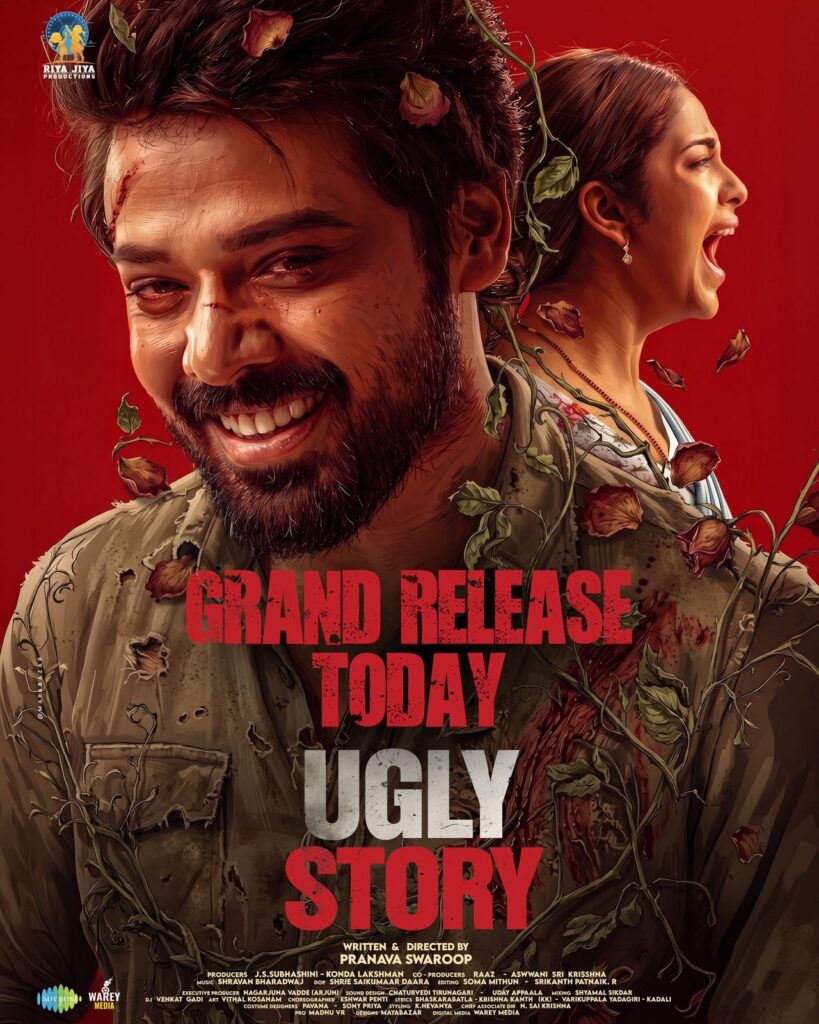
Written and directed by Pranava Swaroop, and produced under the Riya Zia Productions banner, Ugly Story—starring Nandu and Avika Gor as the lead pair—hit theaters today. Sri Saikumar Dara handled the cinematography, while Shravan Bharadwaj composed the music and Srikanth Patnaik served as the editor. Subhashini and Konda Laxman acted as the producers. Shivaji Raja, Ravi Teja Mahadasyam, Pragya Nayan, and others played pivotal roles. Now, moving on to the review of the film…
Story:
Nandu (Karthik) and Avika Gor (Neha) are cousins (specifically, brother-in-law and sister-in-law). Having lost her parents, Avika Gor initially lives with her grandmother. However, after her grandmother also passes away, her maternal uncle—Shivaji Raja (Narayana Rao)—brings her home and raises her. Since the uncle already has a son—Nandu—who grew up without a mother, he has always told Nandu from childhood that Avika Gor is destined to be his wife. However, Avika Gor is already in love with her childhood friend, Ravi Teja Mahadasyam (Gautham). So, how will Nandu end up marrying her now? Will the romance between Ravi Teja and Avika Gor triumph? Will Nandu support their love or stand in its way? Will Nandu receive justice or face injustice because of Shivaji Raja? To find the answers to these and many other questions, one must watch the film on the big screen.
Performances:
In this film, Nandu appears in a completely new avatar—a “psycho” character—a type of role he has never portrayed before. Nandu’s acting performance in this film marks a distinct turning point in his career; one could say that a “new Nandu” is being introduced to the film industry through this movie. Seamlessly shifting his expressions on the fly—whether portraying deep emotion or embodying a complex, psychologically disturbed character—Nandu delivered a truly magnificent performance. Similarly, Avika, who starred in the film, captivated the audience with her portrayal, effectively conveying both innocence and intense emotion. Rather than maintaining a static performance throughout, she modulated her acting style according to the specific demands of each scene, leaving a lasting impression on the viewers. Although Ravi Teja appeared in a role with limited screen time in Mahadashyam, his acting and the impact of his character added significant value to the film; his presence proved to be a major asset. Furthermore, Shivaji Raja delivered a splendid performance in the role of the father. As the patriarch of the family, his reaction to the circumstances facing his son and niece—and the emotional depth he displayed in those moments—left the audience spellbound. Pragya Nayan, appearing in a substantial role as a police officer, also performed exceptionally well. Additionally, all the other supporting actors in the film performed admirably within the scope of their respective roles, contributing positively to the overall success of the movie.
Technical & Film Analysis:
Presenting a psychological narrative in a manner that is easily comprehensible to the audience is a challenging task. Director Pranava Swaroop succeeded admirably in bringing such a complex story to the silver screen in a way that resonates clearly with the viewers. Typically, in films of this genre, the audience tends to feel either anger or pity toward the central protagonist; however, in this particular film, the central character evokes a complex mix of both anger and pity. By crafting such a unique character—and illustrating how the lives of others revolve around them—the director has skillfully steered this film forward, effectively mirroring certain personalities currently prevalent in society. In terms of technical execution, the cinematographer succeeded admirably in capturing the film’s essence through the lens; every single scene was presented in a visually stunning manner. Furthermore, throughout the movie, both the background score and the songs blended seamlessly with the narrative. The editor also did an excellent job, ensuring that scenes were trimmed to the precise length required, avoiding any unnecessary footage. There appeared to be absolutely no compromise regarding locations, VFX, or other technical aspects; the production values were truly exceptional.
Plus Points:
Story, Direction, Background Music, Performances by the Cast, Nandu’s Stellar Performance.
Minus Points:
A few scenes that felt somewhat disturbing or brutal.
Verdict:
Reflecting the “psychopathic” personalities occasionally encountered in today’s society—and shedding light on current social dynamics as well as the hardships some individuals endure in the name of love—this film is a movie that can be enjoyed by the entire family.
Rating : 3/5